Guides
How to choose a marble mandir for your home
Silgar Enterprises · · 3 min read
Measure the space, choose the stone and carving, plan the lighting and keep it easy to care for — a practical guide to planning a marble mandir that lasts for generations.
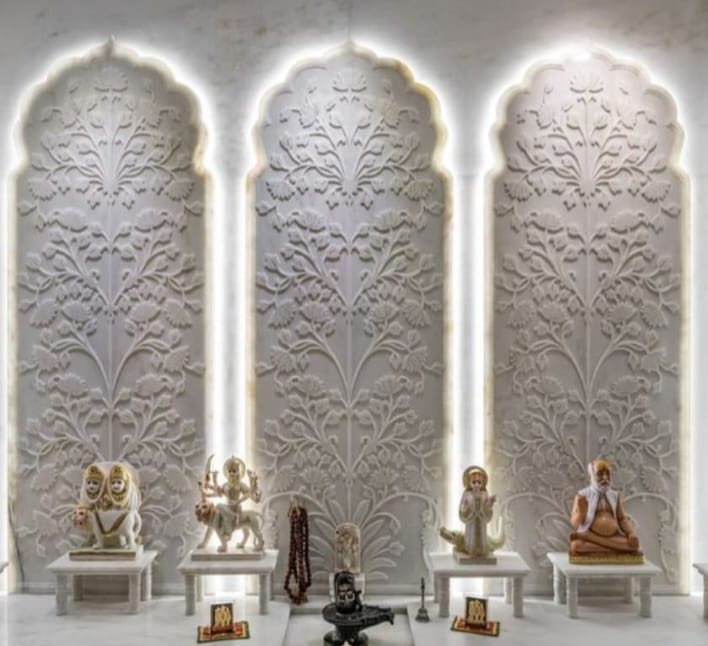
A mandir is the one piece of furniture in an Indian home that is used every single day. A well-made marble mandir stays beautiful for decades, so it is worth planning carefully. This guide follows the order in which we discuss a mandir with our customers.
1. Measure the space first
Before looking at designs, measure where the mandir will stand:
- Width and depth of the wall or niche, including skirting and switchboards.
- Ceiling height, so a dome or shikhar does not touch the ceiling or a beam.
- Door and lift sizes on the way in. Large mandirs are made in parts and assembled on site for this reason.
- Power points, if you want lights inside the mandir.
As a simple rule, the idols should sit at or slightly above eye level — standing or seated, depending on how your family prays. Tell us, and we will set the platform height to suit.
2. Choose the stone
White marble is the classic choice because it reflects light softly and looks calm.
- Makrana white marble from Rajasthan is dense, fine-grained and develops a soft glow with age. It is the most valued Indian white marble.
- Other Indian white marbles are good value, with slightly different shades and veining.
- Italian marble such as Statuario has dramatic veins and large slabs, but it is softer and more porous, so it needs sealing and gentle care.
If you are unsure, request a sample and look at it in your own light. Our guide to Makrana, Indian and Italian marble explains the differences.
3. Pick a style of carving
- Traditional temple style — pillars, arches, a dome or shikhar and fine floral carving.
- Modern minimal — clean lines with one carved panel as the backdrop.
- Jaali work — perforated screens that let light through beautifully.
- Wall-mounted panels — carved arches or relief panels fixed to the wall, ideal for smaller rooms.
Machine and hand work are often combined: CNC carving cuts accurate repeating patterns, and artisans finish the faces, petals and edges by hand.
4. Plan the lighting
Warm white LED strips (around 2700–3000 K) hidden behind a jaali or along an arch make the stone glow without glare. Mark the wiring channels in the drawing so nothing needs to be drilled later, and keep a separate switch for the mandir lights.
5. Placement customs many families follow
Many families place the mandir in the north-east of the home, with the idols facing east or west, and avoid placing it under a staircase or against a bathroom wall. Customs differ between families and regions, so follow what is meaningful in your home — we will adapt the design to it.
6. Practical details that make daily use easier
- Drawers for diyas, incense and books.
- A pull-out shelf for the aarti thali.
- A small lip at the edge of the platform so diyas cannot slide off.
- A raised base that is easy to clean underneath.
7. Caring for a marble mandir
Wipe it with a soft, damp cloth and a mild, pH-neutral soap. Avoid lemon, vinegar and harsh cleaners — acids dull marble. Keep a small brass or glass plate under diyas and incense to catch oil and ash. Our marble care guide covers stains in detail.
Ready to plan yours?
Share the wall size, a photo of the space and the style you like through our custom requirement form. We will send a drawing and a quotation. You can also browse ideas in our pooja room collection.